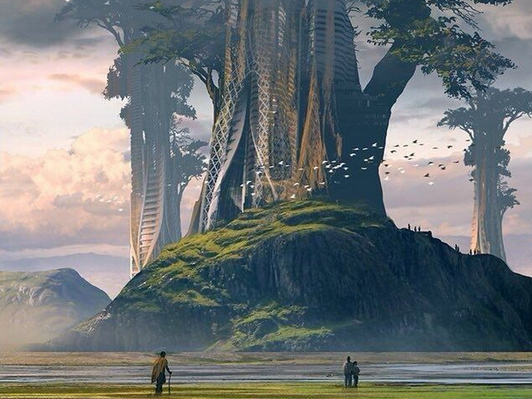
Somewhere within the Kaspian Peaks, hidden in an arcane grove, is the para-spacial structure known only as the Census. Appearing as an Old World megastructure (referred to by historians as a skyscraper), the Census stands roughly 40 stories tall and is clad in a material halfway between marble and steel. The edifice has long since succumbed to corrosion and overgrowth, with vines that snake around the building in a lattice that seems to barely keep the place from crumbling. There are no windows.
If granted admission, the lobby is the first, only, and smallest room in the Census. Though austerely decorated, with drab steel chairs and no visible light source, the room is surprisingly clean and well kept. With the assistance of the Curator, the true interior of the Census is revealed: The Monument Tree. A massive waypoint tree taller than any mountain in Tsamsara, the Monument Tree grows from massive roots in a dream-like field that in no way, could ever fit inside the building. Its branches span kilometers, heavily laden with silver leaves and gossamer pins. With but a thought, it is possible to “go up the tree”, teleporting up to another plane higher up like the floors of a building.
Each plane is its own field, covered pristine wildgrass and dotted by countless statue bases. Some depict people of every shape, age, and size. Most are just empty bases. At the feet of almost every statue, is a patch of bright, violet wildflowers. According to the Curator, there is one statue for everyone who lives and ever lived in Tsamsara. For every person killed, a flower is planted at the base of the murderer, whether by blade, order, or inaction.
As you go up planes, the statues have more and more flowers. Some have patches hundreds of metres across. At the very top, with only the tallest and thinnest branches of the World Tree visible, are 4 statues. Standing together, the statues rest in the middle of a purple sea. The curator states there are over a trillion flowers planted at the base.
